Tuesday, 6 January 2015

Family History 4.41

The next generation

 
In November 1901, Felicia Ann was married to William Bigelow, and the next year they moved to New Plymouth, where William had been moved by his employers, Sargoods, to work in their office, at that time on the site now occupied by Taranaki Newspapers on the corner of Currie and Courtenay Streets.
1902 Bigelow house, David Street, New Plymouth, since moved to
Lepperton, on Mountain Road near the corner of Manutahi Road.
 
There their three children, John Edwin (Jack), Felicia  Mary (Gaze), and Winifred Amy (Wyn Bird) were born and started school.
 
In 1912, with parents getting older, the family moved back to Auckland and the Auckland office of Sargood's, where William was still working, as Chief Cashier (ie accountant), when I used to visit him during working hours as a little boy with my mother, Mary.
 
Joanne continues:
 
He (Joshua Caleb) was very involved with the Baptist Church and a son made the observation, 'that we were all great temperance people and strongly advocate total prohibition.'
 
Their last move was to Westminster Road in Mt Eden and Mary Ann died here in 1916, at the age of 62. Joshua moved to Bank Street in Mt Eden next to his brother-in-law John Newman, (where he was looked after by Felicia Ann and William and their family, and where we used to visit William when we were children - FG).
 
Eleven years later Joshua died in Auckland Hospital on 15 April after a brief illness. He was buried at Purewa with his wife and their son, Arthur.
 
Joshua's official will put the value of his estate at 2310 pounds.
 

Joshua and Mary's children

 
Edwin (1876-1904), a teacher, never married.
 
Felicia Ann (1878-1934), married William Bigelow, had three children.
 
Harold (1880-1917), a painter, married Rosa, had four children, killed at the Battle of Messines and buried at Le Bizet.
 
Ernest (1884-1950), also a teacher, married Gladys and had four daughters.
 
Caroline (1885-1948) married William Judd, a farmer at Matawai in the hills behind Gisborne.
 
Watkin (1890-1963) married Dora, no children.
 
Harvey (1895-1958) a teacher, married Gladys, served as a medic in the Great War, had three children, two of who became Presbyterian ministers and the daughter, Pam, married Richie Poole.
 
Amy (1898-1970) married George Noble.
 

Monday, 5 January 2015

Heart 3


Waikato Again


Margaret, who had gone back to Oakura to be with the children, got the family up early and reached Hamilton by 8 in the morning. The discharge processes however stymied us, and we didn’t get away until 3 pm.  By the time we reached Mokau it was dark, and we stopped for a meal just before the shop closed. 

The recovery at home was slow: each day I walked another lamp-post further up Wairau Road until I could manage the 2 km all in one go.  Friends came to sit with me while Marg and the kids were at school, people like Terry Hickey and Nigel Hayton and Iain Tennent. 

As predicted by the doctors, it took most of a year to recover completely and 12 months to the day, I climbed the Kaitake Ranges again, with a group of special relations and friends and celebrated with another picnic when we reached the summit..  

In 2008 I had another heart attack and again ended up at Waikato Hospital. There the catheter laboratory doctors examined my heart and suggested a stent in the fourth artery. No sooner had I agreed than it was done! They also told me they had checked the by-passes and they were all fit for another ten years. 

The most exciting part of this episode was late that evening when the nurses came to remove the plug in my groin. It took four of them to hold the artery to control the blood-flow, while they removed the plug! 

Sunday, 4 January 2015

Heart 2


At Waikato Hospital

But Tuesday evening I got a call from the cardiac ward that there was a cancellation and could I come straight away. 

So by Wednesday morning I was ready for the op. Margaret was with me all this time and a lonely wait while I was in the theatre. When I moved to ICU for recovery, the blood transfusions kept coming, and the blood kept flowing out of my chest. They tried a few methods of stopping the flow, and in the end would have had to operate again, but fortunately the problem righted itself, after a phone call to the surgeon in the wee, small hours of the morning, and I was moved out of ICU and back to the Cardiac Ward with a nurse to watch me all the time for the next few hours. 

I came to on the Thursday morning, with the sun shining, and Margaret there to greet me.  She was joined soon by Denise, who had driven down from Auckland to support her little sister.  

The nurses then helped me to get out of bed and walk (or stagger) across the room to the basin to wash my face and clean my teeth, which I managed OK. Then I turned around and there was no bed in the room. They told me it had been moved to the other end of the ward and I would have to walk to it. Fortunately I had the assistance of the nurse on one side and an OT on the other. 

I now learned the most important lesson of my subsequent life: I had to walk two kilometres every day from now on. The ward was 50 metres long, so we had do 20 lengths in the day. Every so often, we would get out of bed and walk to the end of the ward and back, and then collapse, exhausted, back on to the bed. 

The other main memory I have of the recovery process was odd perceptions I had, mainly I guess from the anaesthetic. I felt as though there was no wall behind the bedhead, even though there was a wall there when I looked. And I had tickles in my throat, I guess from the ventilator they had inserted to keep me breathing. 

The building was quite old, and I remember the bathing area as very cold, with a southerly blowing off the snow from Mt Ruapehu, which we could see from the windows, because the weather was fine. 

By the end of the week, I was able to walk up a flight of stairs to the next level of the hospital with no drop in blood oxygen percentage, so I was allowed to go home.


Saturday, 3 January 2015

Health Problems

Heart


Anzac Day 1996 was a beautiful day. We started early, because we had decided to climb the Kaitake Ranges in the morning. 

We set off and drove up Surrey Hill Road to the start of the track. Up the first stage of the hill track through farmland, I suddenly found myself short of breath. We stopped and rested for a few minutes, and then I felt better so we continued on. We had done this climb a few times before, so knew the way, and reached the top without incident after around two hours. After eating our lunch at the top, and admiring the view of North Taranaki, the coast up to Raglan, and the mountain behind us, we reluctantly set off down the hill again, arriving home in the early afternoon. 

We worked in the garden in the afternoon and by early evening it was time for a rest, so I sat down in the lounge. I had been resting just a short time when I felt a tightening in my chest. After a few minutes, I realised that this pain was not going away – well, it wasn’t highly painful, just tight. So I decided to phone the doctor’s surgery. Then I had second thoughts. If this might be a heart problem, there was no time to lose, and I knew from my experience working at the hospital that the ambulance guys were the best in emergency situations. 

So we phoned 111 and waited for the ambulance to arrive. Fifteen minutes it took, which was pretty quick, considering they had to travel 15 kms. They hooked me up to their machinery, and said they thought I was having a heart attack. Then we set off for A&E, with Marg following in the car. 

In A&E I joined the standard protocol for heart patients and ended up in ICU a few hours later. I had had a heart attack and was looked after in the ward for a few days and then left hospital to start the process of getting better, or at least of undergoing tests to find out what was happening. 

However, we did not get far along that track before I had another suspected attack about a month after the first. Again the ambulance took me to A&E and I ended up in the medical ward, the old Ward XII, until a transfer was arranged to Waikato Hospital Catheter Lab so I could have an angiogram. 

This involved inserting a catheter in my groin and injecting dye into the heart so they could study the coronary arteries on the screens attached to a scanner. 

The result was a diagnosis that three arteries were largely blocked and needed bypass surgery. And in a hurry. The surgeon explained later that the crude cobalt radiotherapy I had had after my cancer episode had damaged the arteries (probably). 

So late in May we arrived at Waikato Hospital on a Tuesday afternoon and booked in to the hostel there (Hilda Ross) ready for interviews on the Wednesday and admission for surgery on the Thursday. 

Friday, 2 January 2015

Last Sketches for 2014

Back to pencil for this selection.


This house was one we saw in the Barossa Valley on our day trip from Adelaide. We had just visited "Jacob's Creek" and Maggie Beer's Farm, two very well-known spots, and there was this heritage building standing on a corner.
 
 
Early one fine morning I walked down the street to the Te Henui Cemetery, sat on a bench in the sun and sketched these graves. I have no idea of the names on them but they were a picture of peace in the bright sunlight.
 
Another morning I sat under our umbrella on the back patio and looked north to the huge crane which is usually working on the new Hobson Novotel Hotel being built around the corner.
 
The site is usually a hive of activitiy, but with everyone on their Christmas holidays they have hung a banner from the crane and left it to rest. The banner, which advertises the company building the hotel, flaps in the breeze, and if the breeze is strong it slowly rocks from side to side.


One exercise which I try to do regularly is to sketch a head from a newspaper or magazine and this is from a local publicity periodical called LIVE.


Thursday, 1 January 2015

Family History 4.40

Joshua Caleb Robinson

 
In his teens, Joshua Caleb wasted no time when he heard of the gold strike at Thames. He went to Thames to seek his fortune but it eluded him.
 
We don't know what his father said when he came home, but he soon settled down to an apprenticeship with his brother-in-law in the painting and decorating business.
 
Joanne takes up his story:
 
He must have gained some measure of success because, in the next ten years before he married, the electoral rolls show him owning two properties, one in Wellesley Street and a three-roomed house min Wellington Place. When he married on 13 April in 1875 he gave his residential address as Wellesley Street.
 
His bride was Mary Ann Meneer Tremain, the eldest child of Edwin and Ann (nee Meneer) Tremain, who emigrated in the late 1850s from Cornwall.
FG in Egloshale, 2008
 
Egloshale, where they lived, is now virtually a suburb of Wadebridge, up the Camel River from the fishing port of Padstow.
 
They were married at Beresford Hall, the site of the Congregational Chapel, and they made their home at the Wellesley Street property.
 
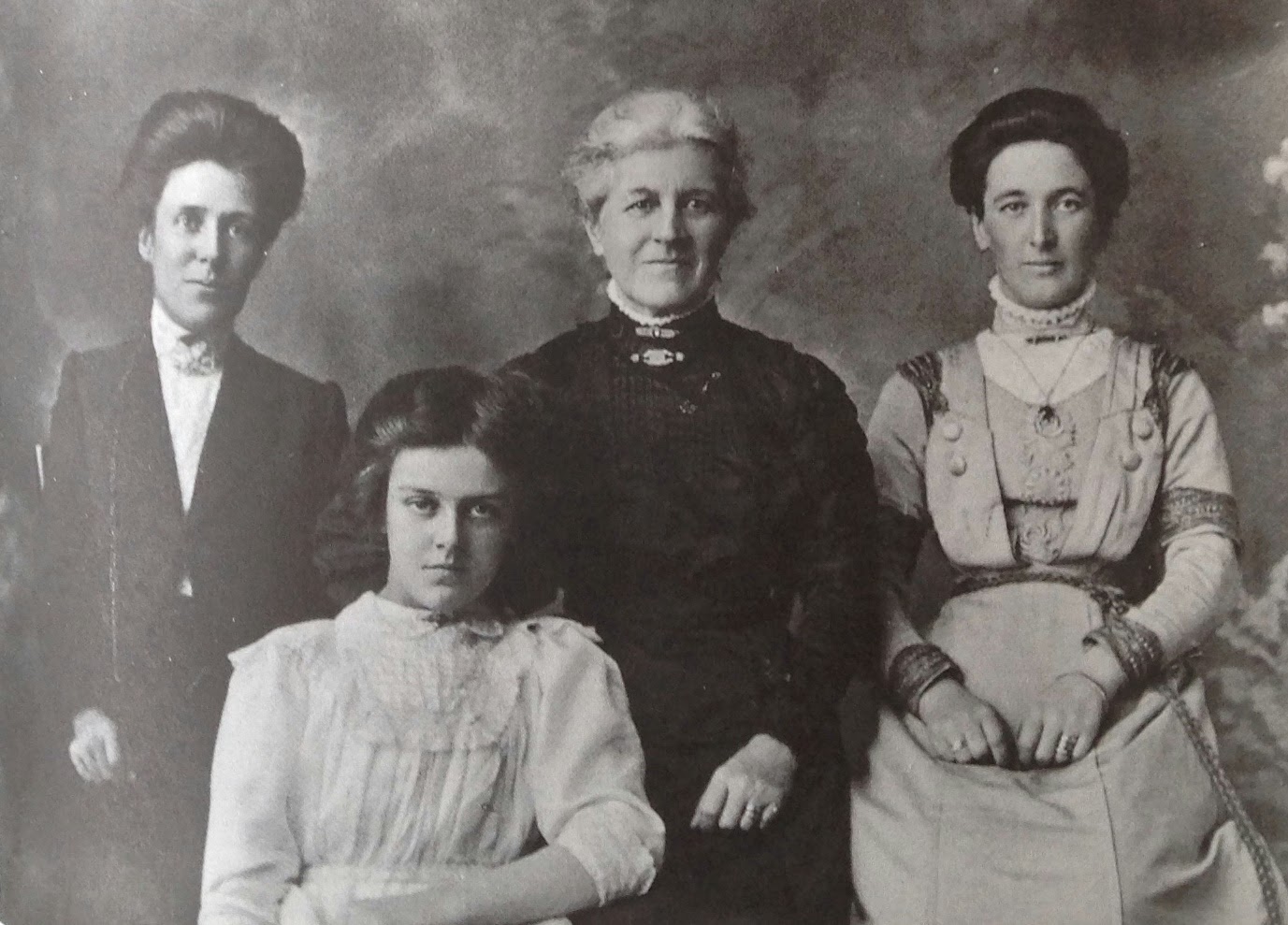
Those first years of married life saw four children born to them: Edwin Joshua in 1876, Felicia Anne Tremain in 1878, William Harold Meneer in 1880, and Ernest Tudor in 1884. Sometime in 1885 they moved to Jervois Road in Ponsonby, and Joshua conducted his business from these premises.
 
The shop in Jervois Road was valued at 28 pounds, and a further wooden building in College Road at 22 pounds. He employed between two and twenty men depending on the work in hand.
 
This residence was where they completed their family, with the addition of five more children: Mary Caroline bron in 1885, Richard Watkin in 1890,Arthur James Osborne in 1893, Harvey Tremain in 1895, and Amy Emma Jane in 1898. Arthur only lived seven months, a combination of measles and bronchitis proving fatal.
Felicia Ann, Mary Ann, Caroline, and in front Amy Emma Jane
 
In 1912, with most of the family grown up, Joshua and Mary moved to Seymour Street in Ponsonby, the business still being conducted from 54-55 Jervois Road. Joshua had also acquired property at Waikumete. By this time his various properties were valued at 900 pounds.


Wednesday, 31 December 2014

Three Cheers for Oz

Anyone, I guess, who crosses the ditch notices some differences from the way things work at home.
 
So it should have been no surprise to us to find some improvements on home once we reached Australia.
 
First was the vigilance of the Airport Security people. Our third plane flight was from Sydney to Canberra and we went dutifully through the security check. Margaret was called back and found a friendly staff member holding her favourite nail scissors. Scissors are a 'no-no' on planes, of course, but we had forgotten them, and the check at Auckland had failed to spot them.
 
She reluctantly agreed to forfeit them and they were promptly in the trash-can. Then she was called again, to find yet another pair of small scissors had been located in the bag, Again, after some discussion about how to post them home if we wanted to, we abandoned the dangerous goods and went on our way regretting our forgetfulness.
 
But it made me wonder if our Government might not be better, rather than rushing tighter security legislation or beefing up the GCSB, to make sure the existing security provisions are being enforced first!
 
Out on the road in Adelaide driving our rental, we were soon aware of the petrol prices, which seemed to vary between $1.30 and $1.50 a litre. Even with the exchange rate allowed for, the difference from the NZ price seems a bit much. With the much lower population density in Australia, the cost of making and maintaining the highway system must be higher over there, so road taxes can't be the explanation for the difference.
 
If our Government wants to give everyone a positive impression of the difference between the two countries, they should use their economic levers to make sure that something as essential and universal as petrol is reasonably comparable in price, wouldn't you think?
 
As we do at home, we watched breakfast-time TV in Australia when we had the chance. Not much difference we thought, except that in the weekends it continues as usual, instead of giving the impression, as it does here, that everything has stopped. Over there they have news, current affairs, and comment on Saturdays and Sundays just like any other day. About time we had it here too!
 
So three cheers for the Aussies on that score!
 
***************** 
 PS Have a look at this editorial on the Stuff website:
 
 
I reckon Rachel Stewart has hit two nails right on the head!