Thursday, 10 March 2016

Historical Project

Over the past couple of months I have been working on a project which has absorbed a lot of time and energy.

This year is the centenary of the founding of the New Zealand Labour Party, and I have undertaken to try to arrange the mounting of an exhibition to celebrate our history in New Plymouth.

Along the way I have found a lot of interesting material. Not all is suitable for exhibition.

But we have fastened on the building of the first State Housing precinct as a suitable peg to hang the exhibition on, because it is tangible, interesting, and contributed a lot to the development of our city.

After a lot of trawling through old newspapers, I have found the reports of the opening of the first houses in New Plymouth in May of 1938. Others working alongside me have located models of state houses from the Auckland University School of Architecture, and maps and plans from the Housing Corporation archives in Wellington

So we are making some progress on that front.

Some of the other details are interesting too. The branches here were kicked off by none other than Walter Nash, who lived here from 1916 to 1920. Labour supporters were active in the local body and general elections of 1918 and 1919.

Nash was also a key person in setting up community support arrangements for people suffering in the influenza epidemic. And probably his most successful project here was in carrying a vote on changing the rating system to unimproved value.

After twenty years of effort, the party eventually managed to elect its first MP, Fred Frost, who had been a clergyman. He served from 1938 until 1943. That parliament was extended to five years because of the war. When he was beaten in 1943, his unpopularity was partly due, so the records say, to his turning up at an event in shorts and open necked shirt!

He was elected in the strong swing to Labour in 1938, just weeks after the first state houses were occupied, and while the drive to build plenty of them had not been halted by the war. So those houses are an important symbol of Labour Party history here.

These three houses featured in a photo in the Taranaki Herald the week they were occupied in May of 1938.
They do not appear to have changed a great deal in their shape in the eighty years since.


Sunday, 28 February 2016

"Pray you undo this button"

King Lear


In my last year at Auckland Grammar School, I was introduced to Shakespeare's tragedy, King Lear, by an inspiring teacher, Owen Lewis.

He had a cunning way of immersing us in Shakespeare: we started reading the play on the first day of the year, and studied it all that week, and then wrote an assignment on it. Had there been a film of the play available in 1950, I am sure he would have arranged for us to see it, because he used films in his syllabus at other times. When I became a teacher of sixth form English I regularly used to start the year by taking the pupils to a film and setting an assignment on it on the first day of the year.

I remember him pointing to this line (Pray you undo this button) and commenting that it showed the depth of dependency that the old king had sunk to, immediately before his death. This request appears four or five lines before the final curtain.

Owen Lewis was in his mid-twenties at that stage, having just returned from service in the Air Force during the war. So he was only about ten years older than us students. Neither he nor we had any idea of what old age was like when you were experiencing it.

In practice, getting older is a case of slowing down. Lots of little tasks become slower or harder or both. Dressing and undressing are among the most frustrating. So "Pray you undo this button" comes to my mind often at such times, although it is doing the buttons up that causes the greatest frustration. No wonder clothing for really ancient people is all held together with velcro!

So was Lear just old, or was he also suffering from dementia, brought on by the deadly feud within his family, between his two older daughters and their youngest sister? He certainly has trouble remembering who his old friends were when they appear. 

Both the slowing of old age, and the extra handicaps of dementia, cause one's world to become gradually narrower and narrower; because ordinary daily life tasks take so much longer, one cannot attend to a lot of wider interests, no matter how involved one may have been at earlier times, and no matter how much one may want to.

And I find myself becoming less and less comfortable about shifting my attention from one absorbing task and moving on to another. If the shift is caused by other people intruding, that is OK, but it is having the initiative to move my own attention from this work I am doing now over to something else, leaving the first unfinished, when I know it is time!

And King Lear's world has shrunk. He suggests to his remaining daughter that they will live "like birds in the cage".

Hang on to your outgoing life as long as you can!

Thursday, 25 February 2016

Inequality Again

Another Subject that won't go away!


The news today is telling us again that the richest 1% now have as much wealth as the rest of the world put together, according to Oxfam.

For months now I have been seeing and passing on articles by Robert Reich, Bernie Sanders, Jeremy Corbyn and Bryan Gould, all talking about the great and growing inequalities in wealth and income across our countries. And some of the "1%", like Gareth Morgan, have been commenting on how ridiculous they see the position too: one billionaire admitted he pays 11% of his income in tax.

So the politicians of this group want to improve the effectiveness of the wealth-equalisation tax systems in their countries.

But an even greater problem, as I see it, is the disparities in wealth across the world. More and more every day the world is being thrown together in one big heap! With cheap travel, fast internet, and frequent sporting links for a start, we are all being forced to realise we are all in this boat together; there is no Planet B.

So we need to start thinking about a system to equalise wealth and income across the world, not just within the boundaries of our artificial nations. Something like a world tax which skims a cent or two off each transaction and enables the poorest nations to use a much larger share of the resulting funds for development projects that improve their long-term conditions. Something at arms length from existing governments and run by widely-representative councils.

Of course such a system needs protection by good quality transparent legal and administrative support, and so on and on. But surely with plenty of computer power it should not be impossible!

What do you think?

Sketching Again


On one of my walks to town and back, I stopped for a rest at the corner of Devon Street and Eliot Street, where there is a comfortable seat among garden plots and a few trees. This is what I could see looking up Eliot Street, with the Boys High Hill on the left, and the building that houses Jenko computers on the right.


Another day I walked in a different direction and passed the site of the planned Gull Service Station which will bring cheaper petrol to New Plymouth.


Last Friday week our sketching group of U3A met for the new year's work at East End Beach, where we had morning tea and a discussion and some sketching at Paris Plage.

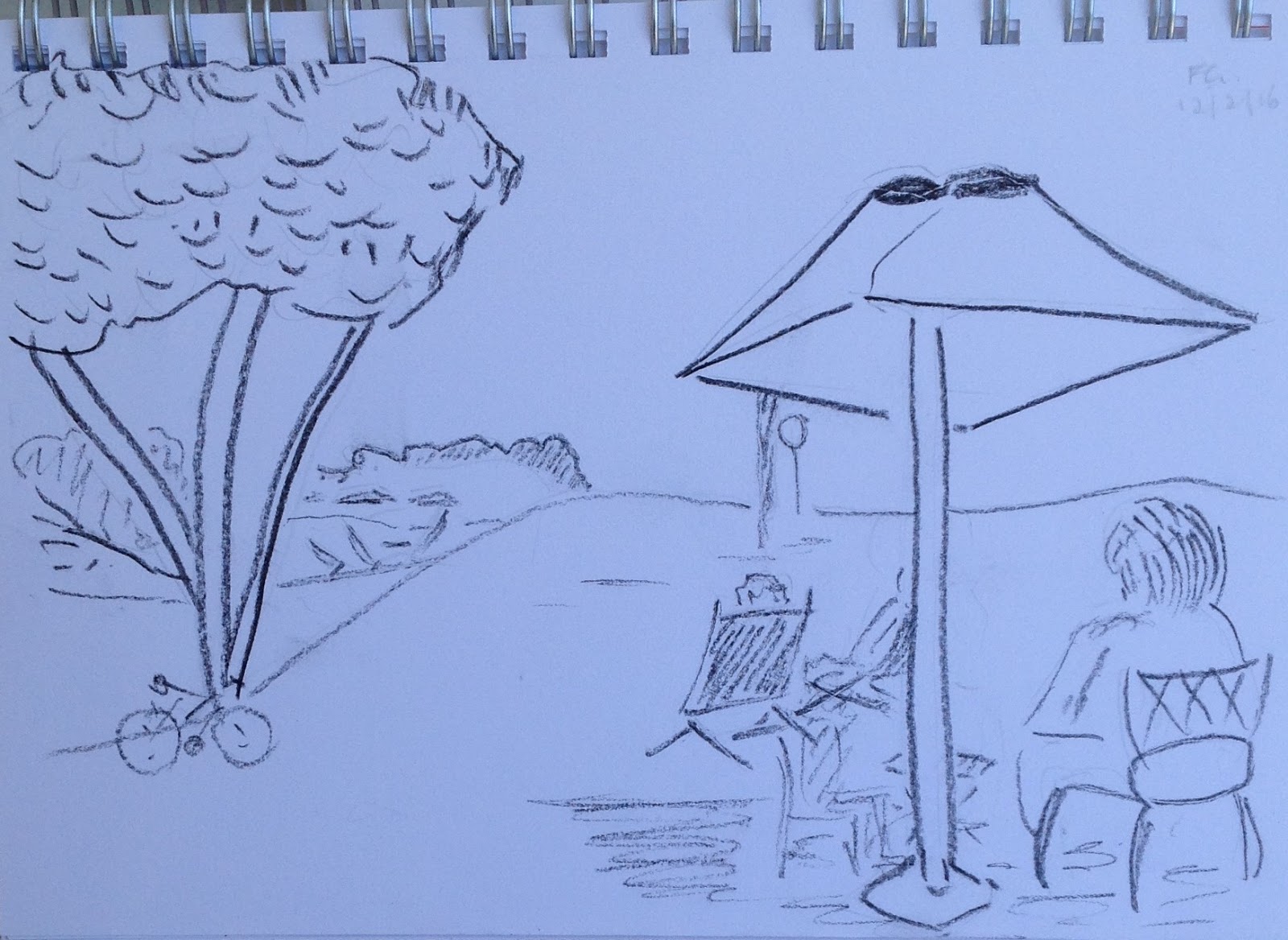
Here is my first sketch, from which you can see that they have made an effort to bring a hint of Montmartre with the bright yellow umbrellas.

The cafe itself is in a couple of old containers, and the almond croissants are to die for.


The proprietors have provided lots of toys for the children, plenty of seats of a variety of styles, occasional live entertainment. There weren't many people there as you can see above, but later it filled up more.

In the weekends they serve pizza in the evenings. As you can imagine in the good weather we've been having for the last six weeks or so the place has been very popular.


Tomorrow we have another get-together at the same place, but I'll find a different subject this time.


Sunday, 24 January 2016

Catchup

What has happened to the sketches?


I know, it's been a while, but I have been beavering away in the meantime. Here is today's:


This is the new hotel just around the corner, the Novotel Hobson, from an angle few people ever see it. Here it is on the right of the street, which is one-way in the other direction. The tree in the background is a very rare one; only two in New Zealand, a Jamaican thorn.

It is really curved like this and the front is completely covered in glass.


Just up the street from the hotel is the hillside with the buildings of the Boys High School dotted around it, and trees and cows of the school's agriculture department among them. At the bottom of the hill is the cricket field with the wet-weather practice shed.

 Near the corner of our garage is a Japanese maple tree. We used to have several maples, but when our house was extended they had to be moved and we gave the others away to friends who had more room.

This one has just been trimmed rather heavily because it will persist in blocking the light from the lamp on the garage corner.


A couple of kilometres away is this house something like 100 years old. There is another one almost exactly the same much closer to us, just around the corner almost, which used to belong to a builder so it is well-preserved.

I have also been copying some other work. First, with some chalk pastels, a copy of one of Matthew's photos which you may have seen on our wall:

And then two from Regency China plates, both scenes from the nineteenth century:


This second one is of an old coaching inn in Bristol, interesting to me because that was where my family worked for some years from 1800-1807 after they left Gloucester and before they made the final shift to London.

Perhaps Great-great-grandfather Gaze worked in a scene like this in the mornings getting the horses and coaches ready to leave for London!

Saturday, 23 January 2016

Scottish History

I.'ve been reading an old book about Scottish history. And what a shambles!

But the most staggering thing is that I had never heard of most of these people. Or of most of the events. Even the ones after King James VI became James I of England.

Yet at school and university I did courses labelled "British History".

I now realise, most of a century later, that what was sold to me was actually English History.

But a lot of the important political leaders, and leaders in science and innovation, were from Scotland.

Now why did all those brainy people accept without protest that British History was a sham?

Tony Blair or David Cameron for instance.

Now I have no ancestral links to Scotland, so far as I know, but it doesn't take much thinking to see that this is another case of colonialism and oppression. And if you read about Wales you get the same feeling, and I do have some links there.

Perhaps living and breathing in New Zealand, with constant debate about the Treaty, has some universal value, and learning Te Reo might be good for every last NZ child who will grow up to take their place in a global society?

Sunday, 10 January 2016

A good film

Last night we watched a good film: the cinema version of Lloyd Jones's Mr Pip.

We were struck by the variety of ideas Jones has packed into the novel. Apart from a cast of interesting characters, and a plot with plenty of action, the themes for the audience to go away thinking about are especially densely packed: differences in culture, the relationship of reality to fantasy or imagination, and are fictional characters like real people?

Through the personality of Matilda, we see the unsophisticated but age-old culture of Bougaineville contrasted with modern culture, peaceful village life contrasted with rebellion and military oppression, Dickens's nineteenth century imagination of Great Expectations compared with life at the end of the twentieth century.  We also get to consider such questions as whether Great Expectations and the Bible are the same kind of book, or whether real-life experience is more valuable than book-learning.

Set on the island of Bougaineville about 2000, the background is a strike by workers at the world's largest tin mine and the oppression of these people and their villages by the government of the day.

Into this situation comes Thomas Watts (Hugh Laurie in the film) to take up a job as village schoolteacher, for which he has no qualifications. His only equipment is his personality and a battered copy of Dickens's novel, which he proceeds to read to the children, and eventually to an appreciative audience of their parents, a chapter a day.

Pip, the hero of Dickens's novel, becomes a central character in the relationship between Mr Watts and the villagers, and especially in his relationship with his star pupil, Matilda, and her mother.

We certainly enjoyed renewing our acquaintance with this story as much as we had enjoyed reading the novel originally. So you have a choice between the book and the film; whichever I know you will find it worthwhile.