Monday, 18 April 2016

Push or Pull

Why did they come?


My friend Tom is writing his family history and has sent us the first chapter to read. It is about the first couple in his family to make the journey from the United Kingdom to New Zealand.

This sort of project always raises the question: why did they make the decision to carry out this amazing change? Was it push? or was it pull?

Tom goes in to the details of why his ancestors left Ireland in the mid-nineteenth century; anyone who has heard of the Potato Famine will have an idea about it.

I have been fascinated by the questions for many years and have tried to give some of the background in my own family history (see earlier posts). But Tom's work has made me think again: did I give enough weight to the Pull factors.

Because in the Gaze family story, the Push factors were there. A young man with a growing family and working in a family business where he was a younger brother and therefore not likely ever to own much of the enterprise, looks for better prospects somewhere else.

Charles Gaze had already looked at the possibility of securing army contracts for his saddlery skills in the Crimean War Theatre. Both that and the Indian "Mutiny" were over by the late 1850s. Land Wars in New Zealand were top of the headlines, so that's where Charles set out for, arriving in Auckland the week the first shots were fired at Waitara.

He got a contract to make haversacks for the army at Otahuhu, so his plan was spot on! He was obviously prepared to look anywhere, so if we had not ended up in New Zealand, we might have grown up in Russia or Turkey or India!

On the other hand my great-great-grandfather, Joshua Robinson, came partly on Pull factors with a much more romantic flavour. He had grown up on the story of Robinson Crusoe and was dreaming of life on an idyllic spot like his hero. At the same time, like many in his era, he had been filled with the desire to help the less fortunate races who lived in less civilised places. 

But there was a more realistic factor too: he met a man in a cafe in London in 1841 who wanted to recruit him, an experienced builder, to set up a sawmill near Auckland. So he managed to overcome his wife's reluctance and they set out before the first organised settler groups for the new colony.

Another great-great, John Bigelow, could have made a living anywhere in the world: he was a shipbuilder in a small fishing village on the northern coast of Nova Scotia. Why he chose to come here out of the rest of the world I can't fathom. 

But his brother-in-law, who had the money, and owned the ship he had built for the voyage, wanted to come this way (perhaps because of gold-rush stories) so in 1860 to the Tasman coasts they came. The ship itself was wrecked a few hundred metres from here a few weeks later.

Robert Goodwin from Northamptonshire, whose daughter married my grandfather, came a generation later. He grew up in a community strongly independent in politics and religion, with a democratic tradition. The progress towards real effective democracy was taking too long for Robert. 

He worked as a slater, building and fixing roofs for the wealthy owners of manor houses. His grandfather had lived through the enclosures, where the wealthy landowners had turned their tenant farmers off the land, and fenced the land for sheep-farming. So there was plenty of Push Factor in his case.

But I have never heard anything about the reasons why he chose New Zealand, although I used to hear my grandmother talk about the voyage out when she was sixteen. He made a real mistake, because no slate rooves existed, except one, in Auckland. He managed OK as a plasterer making ornate ceilings.

So that is perhaps the next project for me.

Meanwhile, we'll wait expectantly for Tom's chapters as they arrive!

Monday, 14 March 2016

A great writer

Hemingway in Love


I have just read this memoir of a relationship with Ernest Hemingway, written by one of his close friends and confidants.

Many years ago, when I was much younger, I read For Whom the Bell Tolls. I recognised the succinct style which he typifies. I enjoyed the story. I also have come to recognise in the title, and in some of his other titles, the point he was making that we are all involved in some of the world-changing events of our lifetimes, even though they may be taking place a long way away. Other examples would be the dropping of the first atomic bomb, or the events of 9/11.

When he was writing, in 1940, I believe Hemingway was pointing out that the Spanish Civil War was a precursor to the Second World War, a trial run if you like. 

And I believe that the Old Man and the Sea, which I read a few years afterwards, also has a kind of "universal hero" aura about it. 

I didn't recognise this feature in A Call to Arms. I read this novel about Hemingway's World War I experiences in Italy later still. Perhaps if I re-read it some day I might see it differently, but thinking back I wonder if the events it describes were too close to Hemingway for real comfort, and he had not, understandably, been able to process them so completely.

Finally, many years later, in fact only a couple of months ago, I got round to reading The Sun Also Rises, his first effort. (See my post of 21 November last)

Hemingway in Love is basically about Hemingway's marriages, about his relationships with all four of his wives, though the process of the break-up of his first marriage, and his developing relationship with his second wife, takes up most of the attention of the book. In fact one could say that Hemingway's regret (remorse, guilt?) about his treatment of Hadley, his first wife, was the main theme of the book.

This memoir is an account, presented as verbatim, of Hotchings' chats with Hemingway during the 1950s while he was visiting the older man in France, Cuba or Key West, where he owned a house, or even during a fishing trip reminiscent of the Old Man and the Sea.

The light the book throws on the novels is not great; it mainly relates to The Sun Also Rises, and for my money does not add a great deal to what we learn from that novel itself. Hemingway admits that his friends, depicted in that first novel in thinly disguised form, were incensed that he had paraded them, warts and all, before their crowd of acquaintances in Paris and elsewhere, and most of them hardly spoke to him again! He misjudged the thinness of the disguises he used -- that is what we learn from Hemingway in Love.

Here is a very human writer, who shows us his strengths and his weaknesses as a human being. For that, as a start, his books are worth reading. Try them!

Sunday, 13 March 2016

Celebrating the Past

A Reunion for 1976


Last weekend Margaret and I travelled to Northland to attend a reunion of the 1976 intake of students at Bay of Islands College in Kawakawa, where we were both teachers.

On the way up we stopped for a walk and rest at Rangiriri, close to a large roadworks project straightening State Highway 1.


This is the view looking east from the school gateway.

When we got to Paihia, we stayed in a cottage at Te Haumi, the beach immediately before Paihia town.


This the view looking up the harbour towards Opua and the wharf and marinas. When I lived there a group of us built a boat ramp at the other end of this beach, to ease the pressure on the ramp at Waitangi. Our old concrete slab is still there. I don't know how much use it gets now, but it certainly improved our popularity with the locals in those days.


This is the view at the northern end of the beach one afternoon, complete with doggy-doos bin! We are looking across the Bay to the area between Opua and Russell.

We spent a morning in Kawakawa sitting in the Trainspotter cafe watching the train run down the middle of the State Highway, and then visiting the Grass Hut shop, where we bought a calendar of prints by Hundertwasser. The shop is owned and run by one of our former pupils.

The reunion itself was fun: the students are now in their mid-fifties. We were also able to re-acquaint ourselves with the school buildings, and with the ten or so fellow-teachers who are still young enough to turn up.

On the way home, we had a stop at Orewa.


This was an older shop on the main road along the beachfront, towards the Auckland end.

_________________________________

This Friday the U3A Sketching Group met at the Te Rewa Rewa Bridge to try our hands at getting it on paper. It proved to be a real exercise in perspective because of its curvaceous design!

So I walked down the walkway a little way to get a more side-on view and eliminate the perspective problems.


Saturday we took the grandchildren to the Multi-ethnic day at the racecourse. Some of the time we sat in the grandstand and watched the dancers performing on the stage. I did a quick, rough sketch of the scene:


Thursday, 10 March 2016

Historical Project

Over the past couple of months I have been working on a project which has absorbed a lot of time and energy.

This year is the centenary of the founding of the New Zealand Labour Party, and I have undertaken to try to arrange the mounting of an exhibition to celebrate our history in New Plymouth.

Along the way I have found a lot of interesting material. Not all is suitable for exhibition.

But we have fastened on the building of the first State Housing precinct as a suitable peg to hang the exhibition on, because it is tangible, interesting, and contributed a lot to the development of our city.

After a lot of trawling through old newspapers, I have found the reports of the opening of the first houses in New Plymouth in May of 1938. Others working alongside me have located models of state houses from the Auckland University School of Architecture, and maps and plans from the Housing Corporation archives in Wellington

So we are making some progress on that front.

Some of the other details are interesting too. The branches here were kicked off by none other than Walter Nash, who lived here from 1916 to 1920. Labour supporters were active in the local body and general elections of 1918 and 1919.

Nash was also a key person in setting up community support arrangements for people suffering in the influenza epidemic. And probably his most successful project here was in carrying a vote on changing the rating system to unimproved value.

After twenty years of effort, the party eventually managed to elect its first MP, Fred Frost, who had been a clergyman. He served from 1938 until 1943. That parliament was extended to five years because of the war. When he was beaten in 1943, his unpopularity was partly due, so the records say, to his turning up at an event in shorts and open necked shirt!

He was elected in the strong swing to Labour in 1938, just weeks after the first state houses were occupied, and while the drive to build plenty of them had not been halted by the war. So those houses are an important symbol of Labour Party history here.

These three houses featured in a photo in the Taranaki Herald the week they were occupied in May of 1938.
They do not appear to have changed a great deal in their shape in the eighty years since.


Sunday, 28 February 2016

"Pray you undo this button"

King Lear


In my last year at Auckland Grammar School, I was introduced to Shakespeare's tragedy, King Lear, by an inspiring teacher, Owen Lewis.

He had a cunning way of immersing us in Shakespeare: we started reading the play on the first day of the year, and studied it all that week, and then wrote an assignment on it. Had there been a film of the play available in 1950, I am sure he would have arranged for us to see it, because he used films in his syllabus at other times. When I became a teacher of sixth form English I regularly used to start the year by taking the pupils to a film and setting an assignment on it on the first day of the year.

I remember him pointing to this line (Pray you undo this button) and commenting that it showed the depth of dependency that the old king had sunk to, immediately before his death. This request appears four or five lines before the final curtain.

Owen Lewis was in his mid-twenties at that stage, having just returned from service in the Air Force during the war. So he was only about ten years older than us students. Neither he nor we had any idea of what old age was like when you were experiencing it.

In practice, getting older is a case of slowing down. Lots of little tasks become slower or harder or both. Dressing and undressing are among the most frustrating. So "Pray you undo this button" comes to my mind often at such times, although it is doing the buttons up that causes the greatest frustration. No wonder clothing for really ancient people is all held together with velcro!

So was Lear just old, or was he also suffering from dementia, brought on by the deadly feud within his family, between his two older daughters and their youngest sister? He certainly has trouble remembering who his old friends were when they appear. 

Both the slowing of old age, and the extra handicaps of dementia, cause one's world to become gradually narrower and narrower; because ordinary daily life tasks take so much longer, one cannot attend to a lot of wider interests, no matter how involved one may have been at earlier times, and no matter how much one may want to.

And I find myself becoming less and less comfortable about shifting my attention from one absorbing task and moving on to another. If the shift is caused by other people intruding, that is OK, but it is having the initiative to move my own attention from this work I am doing now over to something else, leaving the first unfinished, when I know it is time!

And King Lear's world has shrunk. He suggests to his remaining daughter that they will live "like birds in the cage".

Hang on to your outgoing life as long as you can!

Thursday, 25 February 2016

Inequality Again

Another Subject that won't go away!


The news today is telling us again that the richest 1% now have as much wealth as the rest of the world put together, according to Oxfam.

For months now I have been seeing and passing on articles by Robert Reich, Bernie Sanders, Jeremy Corbyn and Bryan Gould, all talking about the great and growing inequalities in wealth and income across our countries. And some of the "1%", like Gareth Morgan, have been commenting on how ridiculous they see the position too: one billionaire admitted he pays 11% of his income in tax.

So the politicians of this group want to improve the effectiveness of the wealth-equalisation tax systems in their countries.

But an even greater problem, as I see it, is the disparities in wealth across the world. More and more every day the world is being thrown together in one big heap! With cheap travel, fast internet, and frequent sporting links for a start, we are all being forced to realise we are all in this boat together; there is no Planet B.

So we need to start thinking about a system to equalise wealth and income across the world, not just within the boundaries of our artificial nations. Something like a world tax which skims a cent or two off each transaction and enables the poorest nations to use a much larger share of the resulting funds for development projects that improve their long-term conditions. Something at arms length from existing governments and run by widely-representative councils.

Of course such a system needs protection by good quality transparent legal and administrative support, and so on and on. But surely with plenty of computer power it should not be impossible!

What do you think?

Sketching Again


On one of my walks to town and back, I stopped for a rest at the corner of Devon Street and Eliot Street, where there is a comfortable seat among garden plots and a few trees. This is what I could see looking up Eliot Street, with the Boys High Hill on the left, and the building that houses Jenko computers on the right.


Another day I walked in a different direction and passed the site of the planned Gull Service Station which will bring cheaper petrol to New Plymouth.


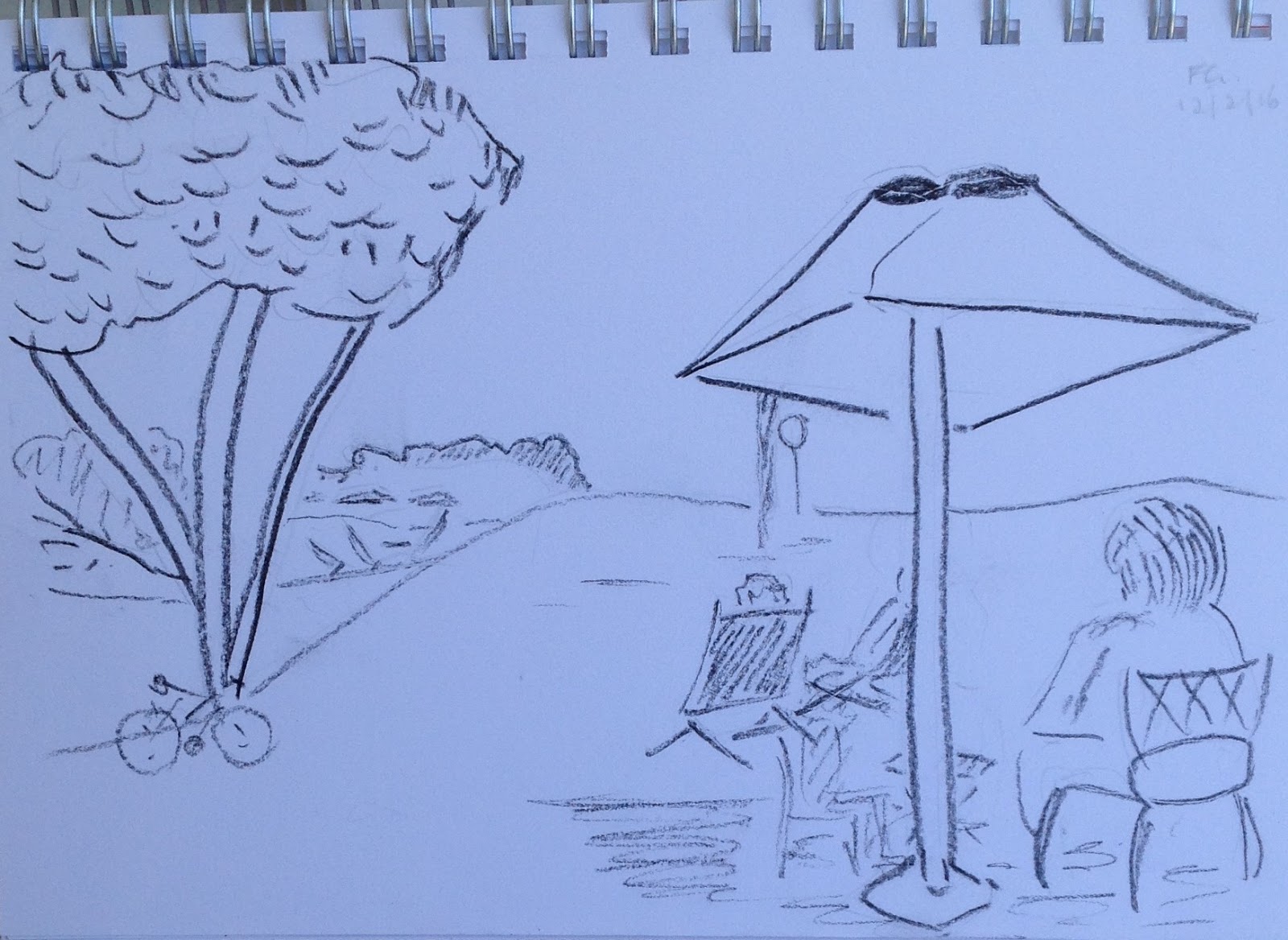
Last Friday week our sketching group of U3A met for the new year's work at East End Beach, where we had morning tea and a discussion and some sketching at Paris Plage.

Here is my first sketch, from which you can see that they have made an effort to bring a hint of Montmartre with the bright yellow umbrellas.

The cafe itself is in a couple of old containers, and the almond croissants are to die for.


The proprietors have provided lots of toys for the children, plenty of seats of a variety of styles, occasional live entertainment. There weren't many people there as you can see above, but later it filled up more.

In the weekends they serve pizza in the evenings. As you can imagine in the good weather we've been having for the last six weeks or so the place has been very popular.


Tomorrow we have another get-together at the same place, but I'll find a different subject this time.