Wednesday, 10 August 2016

Stage Productions

My work as a dramatic producer


Part of my job as English teacher at Rangitoto College in the sixties was to assist my departmental boss, Frank Gee, with the school productions.

The first year he produced "Arsenic and Old Lace" and I understudied him. The next year Frank was more adventurous: he obtained several radio plays from Radio NZ that had never been produced on stage, and we chose three one acters to form the production. He produced the first and third, I ran the second. That was great fun.

At Mt Roskill Grammar I repeated "Arsenic and Old Lace". It is a very tightly written play. Thinking it might run too long, I tried to cut out a section or two, but found it was quite impossible to alter without affecting the thread of the plot.

When I arrived at Bay of Islands College, I found they had already settled on the Mikado as their production for the year. Here is the newspaper coverage from the Northern Advocate:


The staff were very supportive, much more so than in my previous schools.  The science teacher produced fantastic lighting effects and wonderful explosions for Katisha's arrival. About 25 of the teachers helped in one way or another.

Each year after that we produced a musical of some sort.

But 1975 was special, we had an extra production, a very important one. Late in 1974 the Minister of Education asked my Principal if the school could perform a re=-enactment of the signing of the Treaty at the Waitangi Day ceremonies at Waitangi the next February.

So I was asked to produce such a performance. Together with the Maori teacher and a copy of Colenso's account of the day's proceedings in 1840, I wrote and produced a 20-minute version.

Below is the text of the performance, which took place on the Treaty House lawn following speeches by Kirk and Muldoon. The Navy officers had had a mock-tent erected with signal flags, had taught the students how to salute with swords, and had lent their captain's three-cornered hats and uniforms, and their ceremonial swprds to us for the boy playing Hobson to use.


Tuesday, 9 August 2016

Old Photos batch 1

Up to School


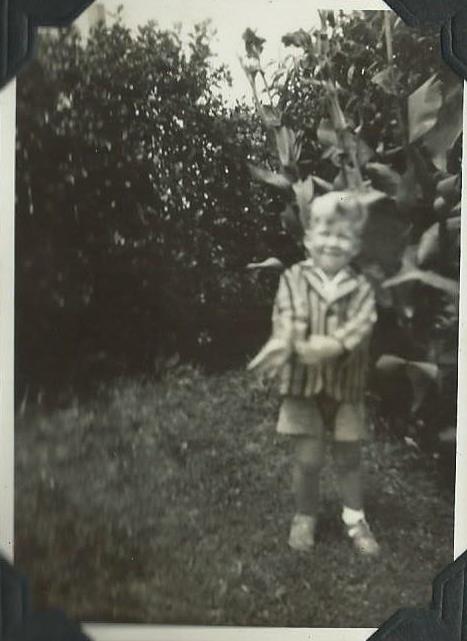
These photos are from an old album compiled by my mother. The first few pages record snaps from my first five years, roughly until the day in September 1938 when I started school. This was at Owairaka School, which was new and wanting to grow, so we were allowed to start school at the beginning of the term of our fifth birthday.

Here I am learning to walk down the steps at my grandparents' bach at Milford on our way to play on the beach. It is summer, so I must have been about 12 months old.


Here I am riding my favourite toy.. I'm not much older than in the previous photo.

Olwyn was born when I was two and a half, and I must have been three to be able to ride such a massive trike!


A more formal occasion


I loved nothing better than playing in the sand on Milford Beach:


Here we are with our Gaze grandparents, Fred and Julia. From Olly's age I cannot have beenmore than three.


Dressed in my Sunday best.


Ready to leave for school that first day. Olly and I are on the front steps of our Ruarangi Road home.


Here is that bike again, this time on the footpath outside our house. By this stage it was two or three years old and I rode it everywhere until the day the main pipe broke at the neck and I came crashing to the ground. 


Another shot with our grandparents, outside the basement of their Mt Eden house.


Here is Olwyn with our first dog, Joe. Joe was a retired sheepdog from our great-uncle's farm at Takanini. Our family looked after him until he died.  He looked after us in return, accompanying me to my music lessons about a kilometre from home, waiting the 30 minutes of the lesson, and then seeing me home again. That was a year or two later when I was seven.


Finally a slightly earlier photo of our family on a holiday outing.


In Memoriam: Ruby Barriball (nee Burnard)

Funeral in celebration of the life of Ruby


When Ruby died in 2010, the family asked me to conduct the funeral. Here are my notes for that occasion:


Five years before, on the occasion of Ruby's eightieth birthday, I had written a poem for her about our trip every Wednesday afternoon at that stage to the supermarket for our groceries. I had watched from that time as she had slowly become more confused abouit what to buy, and had completely forgotten her card number and/or how to use the card to pay for her groceries.


Monday, 8 August 2016

WELCOME

A historic ship


My great-grandfather, John Smith Bigelow, continued the shipbuilding business set up by his father around 1860 when the family immigrated from Nova Scotia.

He eventually wound up the shipbuilding, after completing the last of his ships, Welcome, and having her portrait painted. The portrait now hangs in Terry's house, looking down the street in Freeman's Bay to where the shipyard used to be.

Here is the extract from the register where Welcome (No 82711) was officially recorded:


Railway History

Nineteenth Century engineering


Nearly ten years ago I was part of a team of volunteers who put together an updated edition of a booklet which was by then out of print about the first railway in Taranaki. Our "Centennial" edition (2007 was 100 years since the route had been changed) included several more photos that had been discovered in the archives.

At the same time, we instituted a "Walk" around the streets of New Plymouth following the original railway route.

To explain the walk, and map where walkers should go, we printed a brochure. The numbers on it corresponded with symbols painted on the footpath kerb by the District Council.

Here is the map:


And the text:


Early New Plymouth (to 1864)

In 1840


soon after the signing of the Treaty of Waitangi, the advance party for the European settlement to be called New Plymouth was sent out from Plymouth. It was led by surveyor Frederic Carrington.

When they arrived here, they found a district which had been occupied at various times by many groups of Maori.

Here are the known sites, with their names.


Carrington had been working on the survey of English towns in connection with the drawing up of electoral boundaries under the Reform Act of 1832. Like many other nineteenth century town plans, his one was very formal, a system that went back to Edward I, who built two towns of this format, one at Conwy in North Wales, and the other in Aquitaine, another of his troublesome dominions.

Here is his original plan:


The really surprising thing is how little this plan has changed, even though much of it was not developed until many years later. Lots of these sections and streets are in exactly the same spots today. And very few names have changed. Only the green belt around the outside has been absorbed into the newer suburbs; even parts of that have been preserved as parks and public spaces like schools.

In 1860, the Taranaki War broke out with shots being fired and the British forces suffering a defeat in the first battle near Waitara.

So the military authorities hastily set up a defence system for the town.

The innermost defence was a system of trenches, as shown on this map:


Further away, a ring of fortified lookout sites gave warning of any hostile movement in the surrounding area:


Several of these sites are no longer recognisable, but Marsland Hill, which was the camp and central command post, and Fort Niger are still clearly marked.

One of the most controversial battles was at Waireka, to the west of New Plymouth. For a discussion of the arguments, you need to read James Belich's book on the New Zealand Wars. Here is a map of the Waireka Battle site:

Archiving Documents

We have moved


Since the last blog, we have moved house. This has involved a lot of down-sizing and de-cluttering, as the new house is smaller than the old one.

But we are finding that the selling and giving away and dumping that we did with possessions of a more or less bulky nature now has to be repeated with lots of documents, some of which we have kept for decades.

So the valuable ones, which may be of interest to other members of the family and a friend or two, we are in the process of committing to this blog. Batches of them on different topics will be added in groups; hopefully you will be able to choose which ones interest you.