Thursday, 29 October 2015

Waterloo

I have been reading....


Bernard Cornwell's Waterloo, which is the third version of this great battle I have read in recent years.

The first was the intriguing story of Captain William Siborne. In 1830 he got approval to build a model of the battlefield, and did a vast amount of research in preparation. He wrote to the surviving officers and asked them to tell him where they and their units were late in the afternoon of that 18th June in 1815.

The archive of their letters, with the model Siborne constructed of the battle, constitute the best record of any similar historical event.

Siborne's research suggested that a couple of days before Wellington was hanging about in Brussels when he should have been on the move south to intercept Napoleon's army marching north to defeat him. By the time Siborne was building his model, Wellington was Prime Minister of the UK and so in a powerful position to protect his reputation.

Siborne's project was held up until 1838, when it went on display for 1 shilling a time. Siborne never recouped his expenses, and spent the rest of his life trying to get the army to reimburse him.

I cannot remember the title or author of the second version of the battle I read; it was good on detail but hopeless at giving me a clear overall picture.

There were good accounts of the smaller battles within the main fight: Hougoumount Farm, the French cavalry charge, and some of the skirmishing between Napoleon's troops and the Prussian army coming to help Wellington.

But it is only now that I have read the Cornwell version that I have understood that the battle consisted of three phases: the jockeying for position the day before; the effect of the wet weather which delayed Napoleon's attack until nearly midday; and the battle proper in the afternoon.

I was also glad to find Cornwell had included mention of the contribution of a person with a well-known name in New Zealand: Hussey Vivian. Wellingtonians know Vivian Street, and many New Plymouth residents drive along their own Vivian  Street every day. Vivian was a member of the boards of both the Plymouth Company and the New Zealand Company, being an MP representing the Cornwall and Devon region.

In 1815 he was a young general leading a light cavalry brigade, and their contribution was crucial at a late stage of the battle in swinging the tide more favourably to Wellington's side. In the 1830s he was Master of the Ordnance, ie Minister in charge of the department that ensured the supply of big guns for the army and employed the crew of surveyors who drew the maps as the "Ordnance Survey" of potential battlefields.

Vivian therefore knew about a young surveyor from his part of the country who had made a good job of surveying some of the industrial towns in the Midlands ready for the first democratic elections after the Reform Act of 1832: Frederic Carrington, who was eventually sent to New Zealand to select a site and do the original plan for the town of New Plymouth.

Now I'm reading.....

Killing Patton


but more about that later!

Saturday, 24 October 2015

Safety for Toddlers


I note that Kidsafe is campaigning for us all to back out of our garages more carefully to bring down the numbers of accidents to toddlers in driveways.


There is another tactic which would be effective too: Back in, Drive out.


When you jump into your car to rush off, you are not focussing on the driving, but when you come home you are more likely to be concentrating.


Before backing into your drive or garage, you automatically see the way clear before you change direction.


To reinforce this change in everyone’s habits, councils and private park operators should repaint angle parking areas so the rule becomes BACK IN, DRIVE OUT everywhere, not just in parallel parks.

This simple change should reduce the accident rate by half at least. 


Wednesday, 14 October 2015

More charcoal

This week's sketches


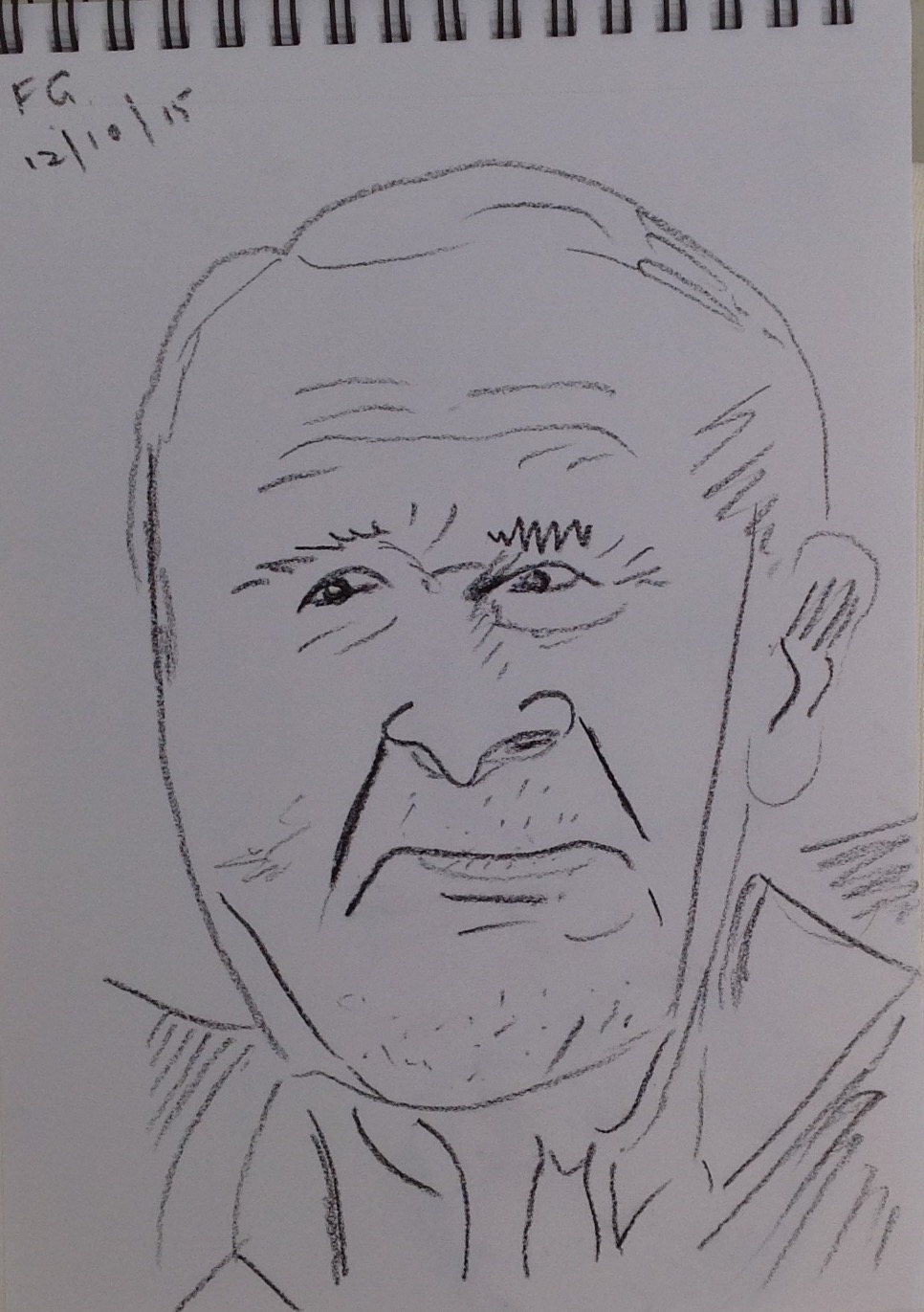
Encouraged by one of the newer members of our sketching group at U3A, I have been working on my skills using charcoal pencil this week, and as my best critic (Margaret) says, the result is an immediate improvement in liveliness of the sketches.

Many of them come from photos in the newspaper, which do not depend on the weather.

On the left is one of Vladimir Putin.

Then there are three from photos in the paper another day, and below on the right a portrait of a South Taranaki resident who is turning 100.


Then there was a shot of this year's capping procession by the staff and students from the Western Institute of Technology here in New Plymouth.

And from the travel pages, a shot of a cottage on a remote island off the Irish coast.


But I have also kept up the watercolours as well.

This is based on a photo taken when we were in Europe a few years ago. 

This is the formal garden in a courtyard of the buildings known as Generalife at the Alhambra in Granada. This was the private part of the palaces, set aside for the Royal Family away from the ceremonial rooms for the administration of the kingdom.


Monday, 28 September 2015

A fascinating scene

Sketching this week 

has included another effort to depict that house on the Chatham Islands that I tried in pastels in a previous post.

This time I tried a watercolour version:

And then for good measure a simple pencil sketch:


This morning, with the sun shining and the wind dropped, I set out early. My drivers licence expires in a few weeks, as happens every two years at my age, and I was headed for the AA office in town to renew it. 

Fortunately the doctor had no qualms about Oking it last week so there was no problem.

A few metres from the AA building I stopped by a small reserve, named in honour of Sir Victor Davies, New Plymouth's leading horticulturalist of the last century, and sketched the view down the street. I was leaning on the brick wall and looking into the sunshine.


 On Friday we had the fortnightly meeting of our U3A Sketching Group. We met at the zoo, where we found some interesting sights to sketch.

Among the inhabitants is this Yellow-crested Cockatoo, which kept saying "Hullo Charlie" the whole time I was sitting nearby sketching the scene.

When I left he farewelled me with "Bye-bye Charlie".

A short way away was the children's playground and behind that a large aviary with lots of exotic birds flying about.

I took a few more photos, including one of some of my colleagues. You can see more of the playground. The other sketchers are disguised as flax bushes!

Here is one of my sketches of the scene. The corner of the aviary is in the corner of my sketch. Unfortunately I was too far away to catch the birds!


Next time our meeting is going to concentrate on drawing crowds of people, basing our work on a seminar from the recent Sketching Symposium held in Singapore and reported on the internet.

So we are all going to be practising sketching body shapes and portraits.

Here is one I tried a few days ago from a photo in the newspaper.

I must keep practising so as to be ready for our meeting!


Monday, 21 September 2015

A good movie

Yesterday we watched a good movie at the cinema complex here.

In the morning we joined the Memory Walk organised by the Alzheimers Society. It was cold and windy, and there had been rain recently, but lots of others braved the weather with us, including Richard Faull, New Zealand's leading brain researcher. He was educated first at Tikorangi School, where Carys and Spencer go.

Saturday evening we joined another crowd who listened spell-bound to his lecture in the Boys High School Hall. We heard about the latest research on the brain, including ideas like keeping our brains active to stave off dementia; if we slow the onset by five years we save 50% of the numbers suffering from dementia in a few years' time.

After all the excitement of the walk on Sunday morning we had lunch at the Art Cafe, run by our friend Sally Johnson. In the later afternoon we walked back to town to see the "Everest" movie.

This spectacular film tells the story of the disastrous 1996 climb managed by New Zealanders Rob Hall and Andy Harris, in which both of them and several others of the party lost their lives. At that time we were just getting friendly with Andy's parents, who had just come to live here.

A few years later we read Jon Krakauer's book, Into Thin Air, which tells his version of events. Krakauer was a reporter who was a member of the ill-fated expedition.

The impact of the film is due to the careful planning, photography and direction, which make the story pretty clear, and give us a good feel of the conditions on the mountain on the day of the ascent.

Teams shot the sequences in Nepal, Italy and the UK. The depiction of both the climbing and the camps is very realistic.We have not visited Nepal, but have been in nearby Indian districts and we felt right at home in Kathmandu, for instance.

The acting was all well done. As the Guardian's reviewer writes, "Emily Watson is terrific as the base camp controller trying to manage the unfolding chaos, and it’s her scenes that pack the greatest punch, her face and voice a pitch-perfect portrayal of alarmed restraint."

I would have liked a bit more of the actual climbing, to balance the emphasis on the human parts of the story, but that would have made the film far too long.

Do see it; we recommend it. We saw the 2D version, but the 3D is probably even more graphic.

Saturday, 12 September 2015

Recent Sketches

By the Harbour

A fortnight ago our sketching group met at the Bach, a favourite watering-hole of New Plymouth folk because it is right by the harbour, with a good view of the sea and the little boats coming and going.

After their excellent morning tea we spread ourselves around the area and did some sketches. Here is a quick one I did of the building which houses the café.


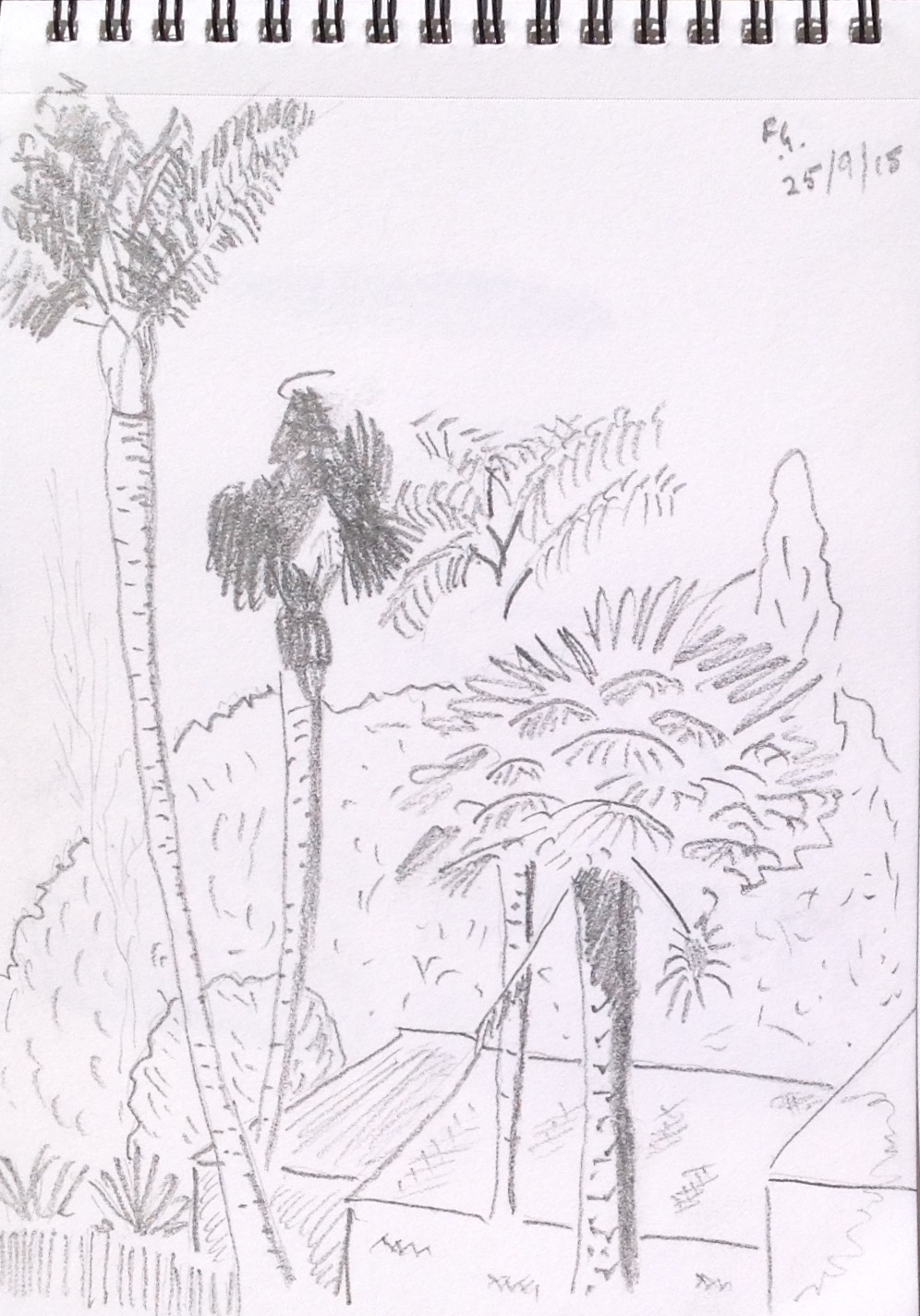
This week we met at another popular cafe, the Tea House by the lake in Pukekura Park. Then, inspite of the cloudy weather, we found places around the park to work. I concentrated on distinguishing different types of trees in a variety of grades of pencils:

I'm not so sure I made a success this time, but at least I have managed to include the shadows rather than the leaves themselves, when drawing ponga trees.

I was sitting outside the cafe looking across the lake to a hillside with a lot of different varieties of trees.

Because the weather has been wintry some of the time, I have been forced to rely on photos for my subjects at other times.

The first is a thatch-roofed cottage in a village we stayed in in rural Hampshire (watercolour only):


Later on our European tour we visited Granada, and in this watercolour  we are looking out two of the decorative windows from the Alhambra Palace towards the Albaycin, the older, originally Muslim part of the city.

In the latest Life and Leisure magazine, which we get as a special deal with our newspaper subscription, is an article on this old chateau in France. This sketch is based on an early 20th century postcard.


Finally a 150 year old cottage at the Chatham Islands, also featured in the Life and Leisure, this time in pastels.


Sunday, 6 September 2015

Fathers' Day

Friday was Rowan's birthday. My older grandson is just coming to the end of his formal education. His little cousin, Spencer is just beginning his, having turned 5 a couple of months ago.

Both of them are focussed, bright boys, hard-working, handsome, with lots of friends. I am extremely proud of both of them and of what they have achieved. 

Rowan has been at the top of his classes and has worked at a part-time job all through university. Spencer practises hard at whatever he is doing and competes with boys twice his size on the football field.

But today I want specially to commend their fathers, Terry and Matt respectively. (And I want to include my son-in-law, Andrew, as well).

They are all in their own way exemplary fathers. Each has worked hard to provide a comfortable lifestyle, home, and education for their children, at considerable sacrifice and effort for themselves. All three are accomplished DIYers, in good Kiwi fashion. And all three have worked hard at their jobs, and still do.

But more importantly all three have put a lot of thought and effort into providing steady discipline and guidance for their children. And above all they are excellent role-models for their families and in particular for their sons. They play a full part in the household chores and by no means leave the care of their children to their wives.

This question of role-models is interesting. I used to find myself unconsciously imitating my father; more recently I have recognised some influences from my grandfathers! Now that I am older than all three of them I wonder if it is my great-grandfather I take after. He was the only ancestor I know of who lived longer!

I can think of several in our family tree who had good relationships with their sons, and many more in the wider family who do today. Long may it continue! 

Have a happy Fathers' Day.