Tuesday, 6 May 2014

Family History 1.114

Gaze History: NSG Memoir

Graduation and first employment


In 1925 Noel graduated Master of Laws, at that time the youngest person to graduate with an Ll.M. from a New Zealand University.  For some seasons he played soccer with a team at the Metro-College Club during these student years. He was, of course, like his family, deeply involved in the work of the church, in Bible Class, Sunday School, Choir and in social and sporting activities organised by the Bible Class Movement.  In the mid-twenties, a large group of Baptist young people who lived in the Mt Eden area got involved in the youth programme of the Grange Road Baptist Church, and Noel and Doris were part of this group.  At an Easter Camp at Milford Beach he was baptised in the sea on the Easter Sunday morning.  No warmed and sheltered baptismal tanks inside churches for that hardy generation!

In the mid-twenties, a sad event occurred: the illness of Noel’s best friend, Frank Crocombe. He was diagnosed with cancer, for which the treatments in those days were much less effective than they are now. One of those treatments was blood transfusion, which in those days was carried out direct from person to person.  Noel volunteered to provide the blood, and the transfer was carried out, but Frank died in spite of it.  Noel always felt he had contributed to the death; the whole family was devastated. 

On 6th September 1926, Noel left his employment with the firm of Stewart, Johnston, Hough and Campbell (Whitaker Chambers, Wyndham Street).  His colleagues passed the hat around and bought him a present, and twenty-one signed this letter:

“Dear Mr Gaze,
                   We, the Staff of the firm of Messrs Stewart, Johnston, Hough and Campbell, with which you have for a good many years been associated, offer you the accompanying present as a token of our hearty goodwill on the occasion of your leaving us.  Your unfailing courtesy and good-humour have been as much appreciated by us all as, we are sure, your promptness and application to work have been by our principals.
                   May you have a really good time on your coming holiday trip and the best of luck when on your return you set up for yourself in business.
                   Yours very sincerely,”


The trip they mention was a holiday in Australia with Fred, Julia and Doris.  They saw the Sydney Harbour Bridge half finished, they toured the Jenolan Caves and the Blue Mountains at Katoomba. 

When they returned, Fred prepared to sell his business and retire, and Noel set up his law practice for himself in an office on the second floor (Level 3) of the Security Buildings in Queen Street, between John Courts corner (now Whitcoulls) and Whitcombe and Tombs.  It was directly opposite the big new Auckland Electric Power Board building built later, close to several banks and handy through a rear entrance to the Lands and Deeds Registry in High Street, and the magistrate’s court nearby.


Zaida Coad (nee Brown) remembers:
 
When I was about 6 and had been seriously ill, I went to Sunday School at Grange Road one Sunday when it was raining. Noel was secretary of the Sunday School.  He said I should go home because I had got wet. I said I wanted my ticket for learning my memory verse.  He said, “I will give you a ticket if you promise to go home.” For a young man he treated me very kindly and I have always remembered him.


Monday, 5 May 2014

Yachting

Learning to Sail


Ever since my first outing in a sailboat at the age of ten while on holiday at Mullet Point in 1944, I had quietly hoped to be able to sail someday. My mentor on that occasion had been a family friend on leave from the wartime navy. 

When Judy died I was searching for diversions and decided to buy a sunburst dinghy. I found one advertised and bought it in Auckland from an old school friend, Jim Feist, who we later met up with again at Sea of Faith Conferences. Its name was “Solace”, which I thought highly appropriate. 

Derek and Lynne Challis had invited me to spend a week with them camping at Mahinapua, near the Cavalli Islands, in early January, so I took the dinghy with me and Derek taught me to sail it on that sunny northern coast between Whangaroa Harbour and Mahinapua. 

I spent a lot of time that year at weekends sailing near to Paihia and teaching myself the rudiments. I only had one mishap: I had taken a friend out to Roberton Island and we were sailing home happily when the wind got up and the boat broached because I had too much sail on. We were tipped into the harbour, and were picked up by a passing runabout.  The dinghy was towed to Russell by a following boat and I collected it a day or two later. 

By the end of the year I reckoned I had had enough practice to try something bigger.  Derek encouraged me and I eventually bought a 27-foot keeler, Stiletto class, designed by John Spencer and soundly built of plywood. It was in Auckland and two sailing friends willingly came with me to Auckland and they and I sailed “Shamal” back to my newly-acquired mooring at Opua, taking a day and a night, non-stop.
 
The only photo of Shamal, at anchor, somewhere in the Bay of Islands,
on a showery day.
 

In January of 1975, Terry and I sailed Shamal on our first major sailing adventure. Before Christmas we headed north along the coast to Mahinapua, and then on to Whangaroa Harbour. Next stop was Taupo Bay for a break, and then we sailed on to Cape Karikari (Matai Bay), where we turned around and headed back to the Bay of Islands for Christmas. This had taken about a week. 

Shamal had four berths, two in the stern and two in the bow. In the middle was a galley, table, navigation desk and storage. Above the stern berths was the cockpit, and between them a motor. 


After Christmas we set out again, this time towards the south. We called at the Poor Knights Islands, spent a night at MacGregor Bay, and carried on to Kawau island, where we spent a day or two sailing around the sheltered waters where I had first sailed all those years ago from Mullet Point. Then we set out across the gulf to Great Barrier. We explored Port Abercrombie and Fitzroy Harbour, and climbed to the top of the island at Mount Hobson to enjoy the view back towards Auckland. 

We set off again towards Whangarei, where I had an appointment with the optician, steering close to the Mokohinau Islands on the way. After a couple of days on the Whangarei Harbour we sailed back to the Bay of Islands by way of Whangamumu Harbour, with its derelict whaling station. 

This trip was when I grew my beard, which has never been shaved since.

Sunday, 4 May 2014

Family History 2.09

Bigelow History: Pre-1630

Ramon Berenguer II, Count of Barcelona

When their father died in 1075, Ramon Berenguer II ruled with his twin brother, Berenguer Ramon. They could not agree, so divided the county, much against the wishes of their father, Ramon Berenguer I.
 
He was known as "the Towhead" because he had especially thick hair on the top of his head.
 
In 1082 he was killed while out hunting in the forest, and his death has been attributed to his brother ever since.
 
After the brother's death, Ramon Berenger's son became the count.


Saturday, 3 May 2014

Family History 1.113

Gaze History: NSG Memoir

More Education


By this time his sister was at Grammar School, and her success would have led to expectations of similar academic prowess for Noel.  He did not disappoint those expectations.  Both Julia and Fred had sharp minds and backgrounds with a good number of educated people in their families. Julia’s ancestors on one side had been among the few literate people in the town of Kettering; Robert’s mother’s father, also Robert, had been asked in 1837 to deliver a lecture to the Historical Association about the history of land tenure in the area. (The manuscript draft is still in existence)  

Fred, who had been forced to leave school in his early teens to go to work, had continued to educate himself all through his life and encouraged his family to take an interest in words, world affairs, mental arithmetic, history and above all the study of the Bible. While Noel was a pupil at Mt Eden School, Fred left his employment with McG and Gower, which had recently been re-structured as John Court Ltd, and set up his own wool retailing and manufacturing business in Karangahape Road.  His colleagues presented him with a silver planter and the inscription gives the date as 23 June 1910. 

In 1916 Noel began his secondary education at the brand-new Auckland Grammar School in Mountain Road.  He continued to do well, although prizes were not to come his way. In 1918 he passed the matriculation examination and stayed on for a sixth form year in 1919.  Schoolboys in those days were more severely disciplined than they are now, but they still got up to some mischief, according to Noel’s later memories.  On more than one occasion the boys in his class all trooped back into school after lunch carrying cicadas and held them to make them sing – all at the same time – much to the annoyance of the teacher.  On another occasion the same teacher arrived at the classroom to find a pile of schoolbags (Gladstone bags in those days) in front of the door and not a boy in sight.  The boys were hiding around the corner and eventually appeared, and picked up their bags to let the teacher into his room.
In 1918, Noel lost his grandfather Charles at 86 years of age.
 
1918-19 was also the period of the Influenza Epidemic.  All around people were dying.  The whole family was ill, but managed to pull through.

In 1920, Noel began his studies at the University College.  His ambition for some time had been to study architecture, or, as some authorities have it, surveying.  However Fred pointed out that many architects found it hard to make a living in those days, and that it would be more practical to pursue a mainstream profession like law.  Noel agreed in the end and entered the Law School.  He worked hard to complete his degree in a short time, and at the same time worked for a legal firm.  After six months working for the first firm for ten shillings a week, he shifted to another one for a rise of five shillings. He graduated Bachelor of Laws in 1923.


 Charles Gaze obituary
 The obituary in the Herald describes him:  “Tall, with silvery white hair and beard, Mr Gaze was a well-known figure at the Tabernacle, being a most regular attendant notwithstanding his advanced years. In fact his attendance only ceased last Sunday and he was spared a lengthy sickness.” He had 22 grandchildren, of whom 5 were on active service at his death, and 20 great-grandchildren.
 

Friday, 2 May 2014

Sketching Week 16

Two heads and two buildings

These two from the newspaper around Anzac Day, veterans both:


 This is the District Council yard in the early morning, from the hill across the street.
 
We used to live next door (1981-84), and every morning they started work at 5 30, so we got used to all the trucks taking off in low gear, and grinding down the street to the corner!
 
 
I used to work in this building when it housed the Social Welfare Department (1980-88).
 
Since then it has been a rest home; now it is up-market apartments!

Family History 2.08

Bigelow History: Pre-1630

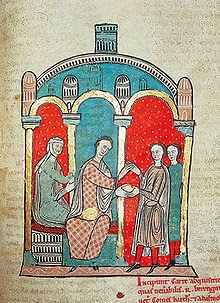
Ramon Berenguer I, Count of Barcelona

 
In contrast to his father, Ramon Berenguer I was a strong leader. He extended the boundaries of the County of Barcelona, by asserting his authority over neighbouring territories, by leading war parties against the Moorish kingdoms to the south, and extracting tribute and plunder from those areas.
 
He was the first count to establish the dominance of the Catalan navy, and the first to establish authority north of the Pyrenees over Carcassonne, for instance.
 
 
All these activities, especially the tributes and plunder (being counted in the illustration on the left), developed the first wave of prosperity for the Catalan region.
 
Ramon Berenguer I was also a law-maker. He codified the Catalan law for the first time, and promulgated it as the Usages of Barcelona, which became the first codification of feudal law in Western Europe. The establishment of law and order was also helped by the Church, which set up "The Peace and Truce of God" whereby for a certain time and over a certain area there was to be no fighting. Catalonia was part of the first experiments in this way of reducing conflict.
 
With his third wife, he began the process of rebuilding the Barcelona Cathedral, to replace an earlier one destroyed by the Moors. Their coffins are still held in the Gothic Cathedral which replaced theirs some centuries later.
 
Ramon Berenguer I died in 1076.


Thursday, 1 May 2014

Family History 1.112

Gaze History: NSG Memoir
Childhood and Education
 
Noel was born on 30 August 1902 and lived all his life in Auckland.  Being the younger child, and quite a bit younger than his older sister, Doris, he could have been a spoilt child.  In addition, his congenital condition, cleft lip and palate, claimed the whole-hearted attention of his parents from the time he was born. 
Feeding a baby with such a condition is even now a time-consuming and difficult task; a hundred years ago it must have taken all the patience and care his parents were capable of.  Nowadays such a baby has operations at a few months of age to correct first the lip and later the hole in the hard palate.  But in those days operations were performed much later and did not turn out so well.  All his life Noel spoke with a nasal intonation which some people found difficult to understand, especially when he was emotionally upset or had a cold. 
Nevertheless, children who have fought hard to overcome such a handicap often turn out to have qualities of determination and reliability.  So it was in Noel’s case.  Add to that a good level of academic and general intelligence, and a pleasant, positive personality inherited from or moulded on that of his father, and there are the makings of a leader. 
Noel grew up in a home where there was constant contact with members of his extended family in and around Auckland. There were regular visits on Sundays to the home of his grandparents, Charles and Alice Gaze, and their two unmarried daughters, Millie and Lizzie, in Franklin Road. Noel and his family attended the same Church as the Franklin Road household.  The family was used to walking and the journeys from Bellevue Road to the Tabernacle on Sunday mornings for Sunday School and Church, and then to Franklin Road and back would have been on foot, at least until Fred bought a car in the late 1920s. 
At Franklin Road they met often with aunts and uncles and cousins like the Stringers from Otahuhu and the Porters.
And of course there were visits to Julia’s parents, Robert and Frances Goodwin, in Newton. There he would hear the family stories about the trip out from England, and about the Mt Tarawera eruption, when the walls of the house moved, and from where the family climbed Mt Eden in the evening to see the reflection of the eruption on the clouds to the south. 
Sometimes they would meet there with Julia’s sister Kitty and her husband George Crocombe and their three children.  There was Dolph, Leone and Frank.  Frank and Noel were closest in age, and they became great friends throughout their boyhood. 
Within easy walking distance from Bellevue Road was the Mt Eden District School, growing rapidly as the suburb filled up with young families.  For seven years Noel trudged up the road each day to Mt Eden School for the obligatory education.  One of Noel’s fellow-students at primary school was Douglas Robb.